
Industries · Clinical research
Clinical Research Marketing Measured in Randomizations.Patient recruitment for clinical research sites: study pages, IRB-ready ads, a volunteer CRM and pre-screening.
Visual Realm is a clinical research marketing agency in Tampa Bay. We recruit study volunteers for research sites with plain-language study pages, recruitment ads written for sponsor and IRB review, and follow-up that turns inquiries into screened, randomized participants. For one Tampa Bay research site, that took enrollment from 8 randomizations a year to more than 100.
Clinical research workTampa Bay research siteTwo research sites and a Phase I unit. From 8 randomizations a year to more than 100.Read the case study IRB-ready ad submissionsRecruitment ad copy prepared for sponsor and IRB review across gout, cutaneous lupus and Sjögren’s studies.10,000+ volunteer databaseProspective volunteers in the CRM since May 2025, each study application tracked separately.
Why clinical research is different
Recruitment marketing with a regulator in the room.
Research by the Tufts Center for the Study of Drug Development found that 11% of sites in a typical trial never enroll a single patient and 37% under-enroll. Recruitment decides whether a site earns the next study, and it runs under rules most agencies have never worked with.
Every patient-facing word is reviewedThe FDA treats recruitment advertising as the start of informed consent, so ads and study pages go to the IRB before use, usually after the sponsor signs off.Ad platforms treat you as health dataMeta restricts data from health and wellness websites, and condition-specific pages can lose conversion tracking entirely. Google allows trial recruitment ads under its own healthcare rules.Studies open and close on someone else’s clockEnrollment windows, sponsor targets and protocol changes set the pace. Marketing has to launch fast for a new study and stop cleanly when it closes.Trial software was not built for marketingSite CTMS platforms rarely connect to ad platforms or CRMs, so follow-up and pre-screening have to be built around them.
Clinical research results
From 8 randomizations a year to more than 100.
A multi-site Tampa Bay research company tried several agencies before it came back to us in December 2024. These are the numbers from that engagement, and where each one comes from.
Enrollment8 → 100+Randomizations a year
Enrollment
Randomizations, not clicks.
Under previous agencies the site averaged 8 randomizations a year. With a rebuilt website and study pages, compliant Facebook and Instagram ads, CRM automation and a reworked recruitment process, it now randomizes more than 100 volunteers a year.
Where the number comes fromThe client’s enrollment records. A randomization is a qualified volunteer enrolled and assigned in a study, the number sponsors judge a site by.
Study pages
One study page, 5.7x the search clicks.
Rebuilt on our study template, the asthma study page went from 37 to 211 search clicks in a quarter, and its click-through rate rose from 0.5% to 3.0%. Every study page now answers what the study involves, who may qualify, compensation and where it runs.
Where the number comes fromGoogle Search Console for the study page, July–September 2026 compared with July–September 2025.
Study page5.7xSearch clicks to the asthma study page
Volunteer database10,000+Prospective volunteers in the CRM since May 2025
Follow-up
A database every new study can recruit from.
Each form opens an application for that study in the CRM, and volunteers get pre-screen questions by text. A volunteer who does not qualify for one study stays in the database for the next one, so each new study starts with people to contact.
Where the number comes fromContacts in the site’s CRM since we launched it in May 2025.
Condition content
Reaching patients before they search for a trial.
Search clicks grew 65%, from 1,830 to 3,011, and clicks from searches without the company’s or its doctors’ names grew 38%. An article on the latest rheumatoid arthritis treatments drew 484 clicks in one quarter, and one on whether lupus is hereditary earned more than 82,000 impressions.
Where the number comes fromGoogle Search Console, July–September 2026 compared with July–September 2025.
Search+65%Clicks from Google search, year over year
AI search visibility
Patients now ask AI where to join a trial. AI names our client.
We track five questions Tampa Bay patients ask about clinical trials, every day, in ChatGPT, Gemini and Perplexity. Here is how often the answers name the research site we market.
Named in83–100%of AI answers, depending on the questionChatGPT named our client in every answer, every day we tracked.ChatGPTGeminiPerplexity
79/86AI answers named our client across all five patient questions we track.#1Most-cited website in those answers. Its site earned 22% of every citation, more than twice the next source.5 of 6Times ChatGPT listed it first when asked for the best places to join paid clinical trials in Tampa Bay.
The receiptsThe questions patients asked, and how often the answer named our client“Which clinical research sites in Clearwater, FL are enrolling volunteers?”100%15 of 15 answers100%“How do I join a rheumatoid arthritis clinical trial in Tampa?”100%17 of 17 answers100%“Are there lupus clinical trials near Tampa, Florida?”89%16 of 18 answers89%“What are the best places to join paid clinical trials in Tampa Bay?”89%16 of 18 answers89%“Are there Sjögren’s syndrome clinical trials in Tampa or Clearwater?”83%15 of 18 answers83%
Source: Visual Realm AI visibility tracking in Screpy. Five patient questions, asked every day in ChatGPT (OpenAI), Gemini (Google) and Perplexity, US English, October 29 to November 3, 2026. 86 answers analyzed; our client was named in 79. Citation share counts every source the three platforms cited in those answers.
IRB-ready by design
How a recruitment ad gets approved.
The FDA’s guidance on recruiting study subjects treats advertising as the start of informed consent, and IRBs review it before it runs. We write for that review from the first draft, so approval is a formality instead of a rewrite.
1Study detailsProtocol, NCT number, eligibility, visits, compensation and sites, taken from the sponsor’s approved materials.2Submission draftEvery primary text, headline, description and image laid out in the submission format your IRB already approves.3Site reviewYour recruitment coordinator checks it against the protocol and sends it on.4Sponsor and IRBThe sponsor reviews, then the IRB. Changes come back to us, not to a new draft.5Build what was approvedApproved copy goes into the ads word for word, and the study page is matched to it before launch.
How we describe a studyInvestigational study medicationYou may qualifyPlacebo, when the study uses oneStudy visits at no costWhat every ad avoids“New treatment” without saying investigationalClaims the study drug is safe or works“Free medical treatment”Payment in bold or larger typeWhat every ad includesThe condition being studiedA summary of who may qualifyTime and visits involvedLocation and how to reach the siteWhat every page matchesThe approved ad languageCompensation as “up to” an amountProtocol and NCT numbers in schemaAn enrollment form for that study
What we do for research sites
Clinical trial patient recruitment, start to finish.
Every service ties back to one number: randomizations. Start with Facebook and Instagram recruitment ads or SEO for your study pages, or let us run the whole recruitment system.
Study pages and searchStudy landing page templateCondition content patients search forA page for every research siteMedicalStudy and physician schemaRecruitment adsFacebook and Instagram ads by siteGoogle Ads where policy allowsIRB-ready ad copyCreative for each studyVolunteer follow-upCRM with an application per studyPre-screening by textRecruitment team follow-up processA database for the next studyMeasurementRandomizations by study and sitePrivacy-aware conversion trackingServer-side conversion signalsMonthly reporting
Choosing a partner
How to choose a clinical research marketing agency.
Research sites can hire national recruitment platforms, healthcare agencies or a generalist that takes any client. Ask each of them these questions.
Do they know what the IRB will ask for?
Ask to see a recruitment ad they have taken through IRB review. FDA guidance says ads should not claim a study drug is safe or effective, call it a “new treatment” without explaining it is investigational, promise “free medical treatment” or put payment in bold or larger type. An agency that knows this writes copy that passes on the first submission.
Do they report randomizations?
Clicks and form fills are easy to inflate. Sponsors judge a site by how many qualified volunteers it enrolls, so the agency should report pre-screens, qualified volunteers and randomizations by study and by site.
Can they track without sending health data?
Meta classifies health and wellness websites and restricts what they can send, and condition-specific providers can lose lower-funnel tracking entirely. Ask exactly what their setup sends to each ad platform. Ours keeps the pixel off condition-specific pages and limits server-side conversion data to hashed contact details.
Do they build for the next study?
Studies open and close all year. A study page template, an approval path, an ad structure and a volunteer database that carry into the next study are worth more than a single campaign.
How it works
From enrolling study to randomized volunteers.
1Study auditEnrolling studies, randomization targets, where volunteers come from today and how fast your team follows up.2Recruitment planWhich studies and sites need volunteers first, with budgets and the approval timeline.3Build and approvalStudy pages, ad copy, CRM and pre-screening built. Nothing launches until the sponsor and IRB sign off.4Measure and growReporting on randomizations by study and site, then more of what enrolls.
Clinical research experience
What clinical research marketing looks like with us.
Real work from a research site we market today, and how we approach it.
Back after a string of agencies
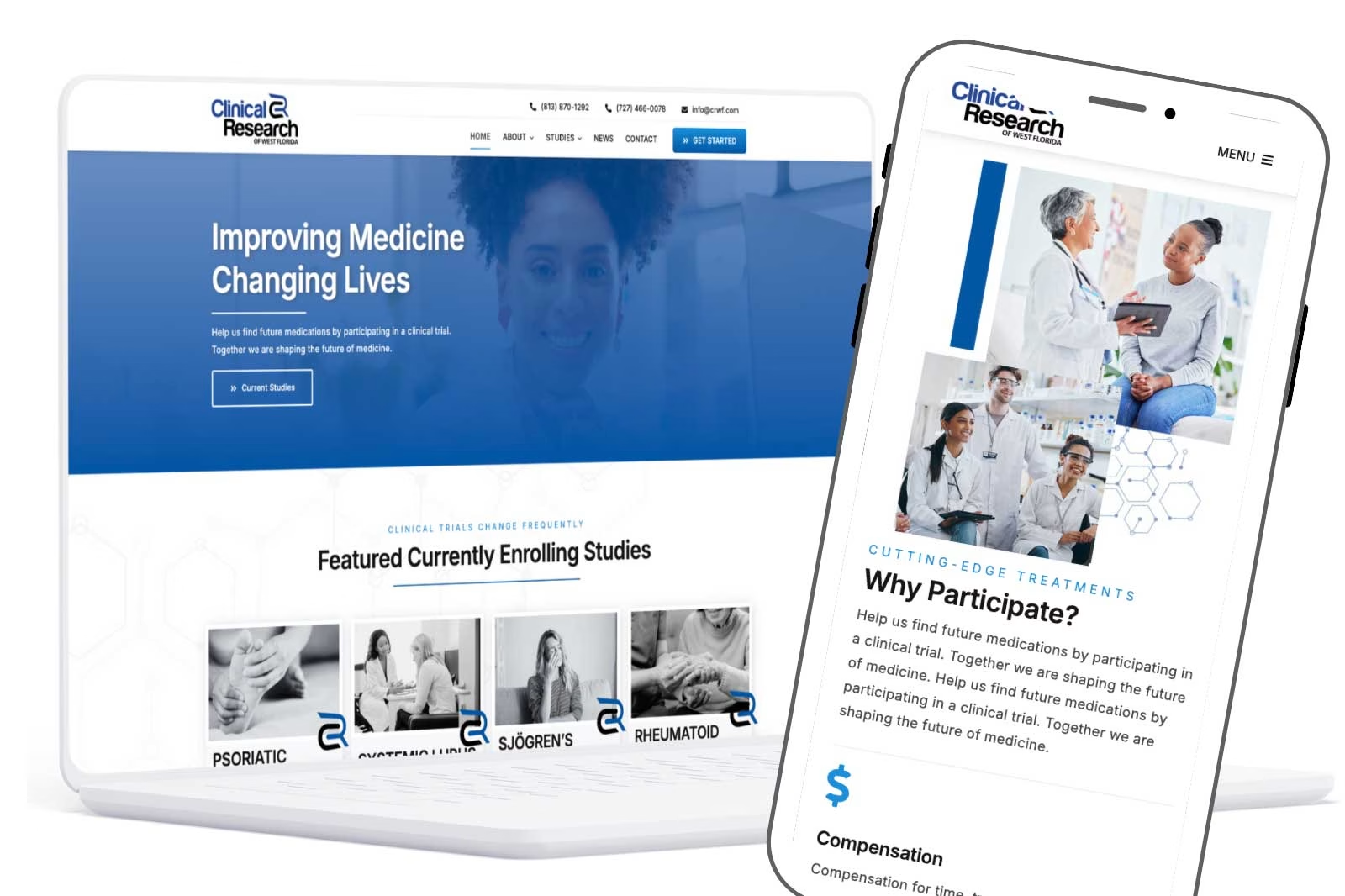
We first worked with a Tampa Bay research site in 2015. It moved through several agencies and averaged 8 randomizations a year, then came back to us in December 2024. With two research sites, a Phase I unit and 16 condition studies on its website, it now randomizes more than 100 volunteers a year. Read the clinical research marketing case study.
Ad compliance submissions
We have prepared Facebook ad compliance submissions for gout, cutaneous lupus and Sjögren’s studies, listing every primary text, headline and description for sponsor and IRB review. When a study’s protocol changes its visits, compensation or sites, the study page is updated before the approved ads run.
One template for every study
Every study page answers what the study involves, who may qualify, compensation and locations, with an enrollment form for that study. MedicalStudy schema carries each study’s NCT numbers, so search engines and AI answers know what the study is, where it runs and who leads it.
Applications, not just leads
In the CRM a volunteer is one contact, and each study they apply to is its own application. One person can be screened for a gout study this spring and a lupus study next year without duplicate records, and the recruitment team sees every study they have asked about.
Campaigns split by research site
Separate Facebook and Instagram campaigns run for each location, because both sites need volunteers. We have managed about $267,000 in recruitment ad spend for the site since April 2025, through our Facebook advertising and marketing automation work.
Follow-up around software with no connectors
The site’s trial management system has no off-the-shelf integration, so we built follow-up and text pre-screening around it in the CRM. Our healthcare work for practices and clinics is on our healthcare marketing page.
Keep reading
Related industries and case studies.
See the full engagement behind these numbers, how we market other healthcare organizations, or view every industry we serve.
HealthcarePatient acquisition for practices, clinics and clinical research sites.Learn more Senior LivingTours and move-ins for assisted living and memory care communities.Learn more EducationInquiries and enrollments for schools, colleges and training programs.Learn more NonprofitsDonors, volunteers and Google Ad Grants for charities and foundations.Learn more
Questions
Clinical Research Marketing FAQs
Questions research sites ask before hiring a clinical research marketing agency.